Check the percentage denominator: this tool needs sulfuric acid as a share of the whole battery. An SDS electrolyte percentage can include water. See the five-model source comparison before replacing the example inputs.
Example filled in: 12 batteries at 2,000 lb each. Change the numbers to match your site.
Yes. Sulfuric acid reaches the Tier II threshold.
14.4 times the 500 lb threshold. Report it for the calendar year by March 1. At 1,000 lb or more, the emergency planning notice under EPCRA section 302 also applies.Sulfuric acid (lb) = batteries × weight per battery (lb) × acid share
Report when the total is 500 lb or more at any one time during the year: 40 CFR 370.10(a)(1).
Default share of 30%: EPA Region 3, Allen Distribution consent agreement, April 15, 2025.
The calculator runs in your browser and sends nothing anywhere. It checks sulfuric acid, plus one of EPA's two options for the other battery components.
| Key facts | |
|---|---|
| Threshold, sulfuric acid | 500 lb across every battery on site (40 CFR 370.10(a)(1)) |
| Acid share EPA used | About 30% of battery weight, Allen Distribution order, April 15, 2025 |
| One 2,000 lb battery | About 600 lb of sulfuric acid at that share |
| Section 302 notice | Also applies at 1,000 lb of sulfuric acid |
| Report due | March 1, for the previous calendar year |
Why batteries count
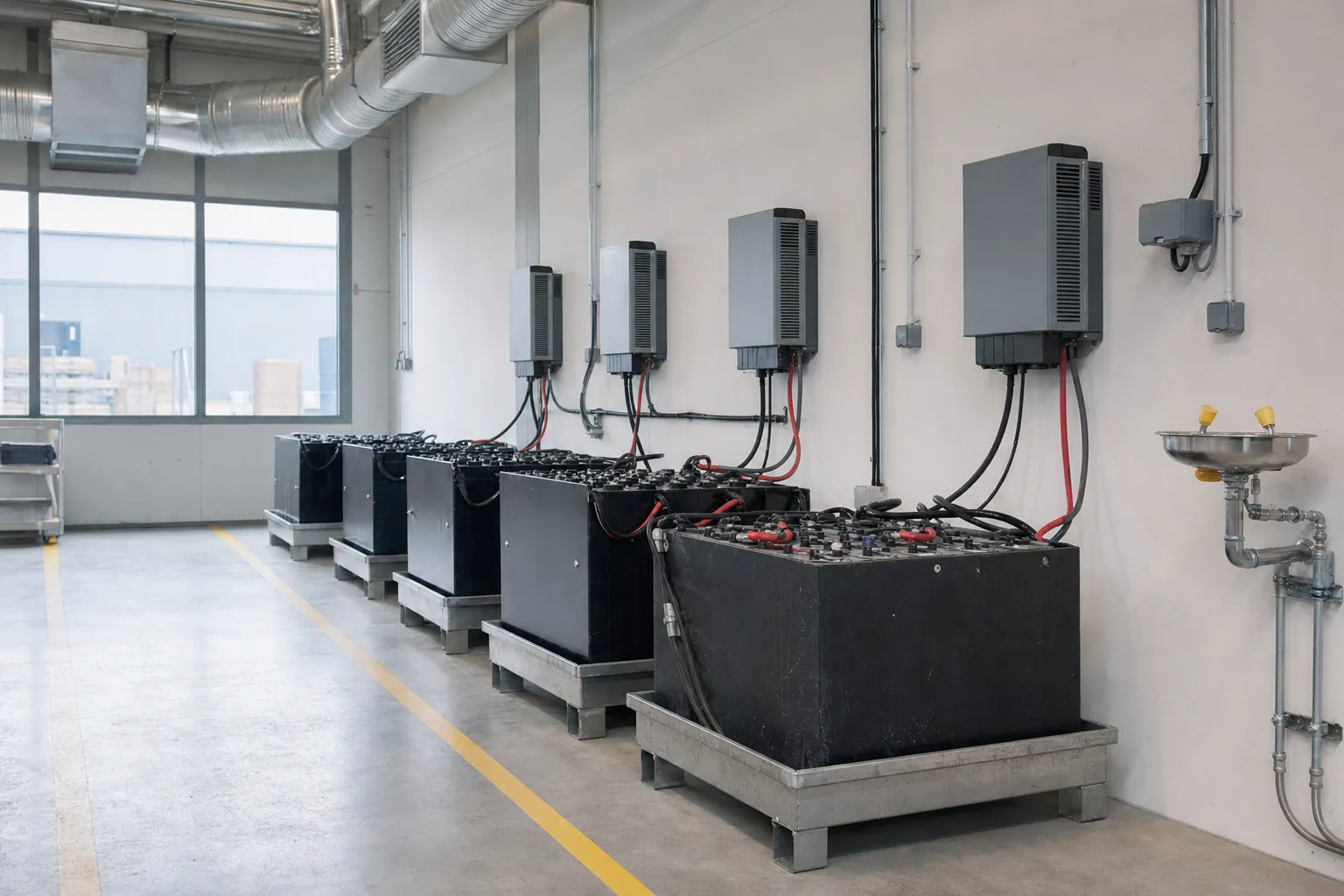
EPCRA exempts a chemical that is present in the same form and concentration as a product packaged for the general public. EPA's answer on forklifts is direct: that exemption does not apply to the type of batteries normally used in electric forklifts, and the chemicals in them must be counted toward the section 311 and 312 thresholds.
Sulfuric acid is an extremely hazardous substance. Its Tier II threshold is 500 lb or its threshold planning quantity of 1,000 lb, whichever is lower, so 500 lb. Because it is an extremely hazardous substance, you add up the sulfuric acid in every lead acid battery on site, plus any other sulfuric acid you store, before you compare it to the threshold.
Count every battery on site
The test is the largest amount present at any one time during the calendar year. Count the batteries in trucks, the spares in the charging room and any battery that sits on site waiting for service or pickup. In the Allen Distribution case EPA counted 33 batteries in forklifts and 23 spares, 56 in total.
Battery weight is on the nameplate or the spec sheet. The acid share is the uncertain input. EPA's own guidance on lead acid batteries gives no single percentage, so the calculator uses the figure EPA applied in a 2025 enforcement order and lets you replace it with the sulfuric acid content from your battery's safety data sheet.
What about the lead
Lead and the other battery components are not extremely hazardous substances, so EPA does not require you to add them up across batteries. EPA's memo on lead acid batteries gives two options: compare the total weight of the batteries to the 10,000 lb threshold for other hazardous chemicals, or add up each chemical on its own across the site. The last line of the result applies the first option.
How to report the batteries
Once the acid total reaches 500 lb, EPA accepts either form on the Tier II report: list sulfuric acid on its own, or list the batteries and show sulfuric acid as an extremely hazardous component. EPA asks that the section 311 and 312 reports describe the batteries the same way. The report is due March 1 for the prior calendar year, in the system your state uses.
Worked example: from battery list to Tier II entry
Illustrative numbers. A building runs 10 electric forklifts and keeps 2 spare batteries on the charging stands, all about 2,000 lb. This is how the result above turns into the entries on the report.
| Step | Figure | Rule |
|---|---|---|
| Batteries on site at the peak | 12, spares included | Largest amount at any one time: 40 CFR 370.10 |
| Total battery weight | 24,000 lb | Nameplate weights |
| Sulfuric acid at 30% | 7,200 lb, 14.4 times 500 lb | Share EPA applied in the Allen Distribution order |
| Maximum amount range code | 05 (5,000 to 9,999 lb) | EPA Tier II instructions, May 2026 |
| Average daily amount range code | 05, if the fleet is on site all year | Total of daily weights divided by days on site |
| Days on site | 365 | EPA Tier II instructions |
| EHS box | Yes: sulfuric acid is an extremely hazardous substance | 40 CFR 355, Appendix A |
| Section 302 notice | Owed: 7,200 lb is over the 1,000 lb threshold planning quantity | 40 CFR 355.10 |
| Batteries against 10,000 lb | 24,000 lb, so the batteries or their lead are reported too | EPA lead acid battery memo, first option |
If the battery SDS gives a lower sulfuric acid share, say 20%, the same fleet holds 4,800 lb, range code 04 (1,000 to 4,999 lb), and it still crosses both 500 lb and the 1,000 lb planning quantity.
What happened at Allen Distribution
Allen Distribution runs a trucking distribution center in Mechanicsburg, Pennsylvania. The local emergency planning committee told EPA the site had not filed Tier II reports. Asked by EPA, the company reported 56 lead acid batteries weighing 111,997 lb in total, about 2,000 lb each. At about 30% acid, EPA counted 33,599 lb of sulfuric acid, 67 times the threshold.
The company then filed reports for 2021 to 2023 that listed lead as the only hazardous substance. EPA treated each year as incomplete for leaving out the acid. The settlement, filed April 15, 2025, carried a $28,152 penalty.
Common questions
Do lithium-ion forklift batteries count?
They can. EPA says lithium-ion batteries are not "articles" under OSHA's hazard communication standard, and the consumer product exemption does not cover large commercial batteries. They hold no sulfuric acid, so this calculator does not apply to them. See lithium-ion forklift batteries and Tier II.
Do I count batteries that are out for service?
Count every battery physically on site on the day of your largest inventory. A battery that left the site for repair does not count while it is gone.
We lease the forklifts. Do the batteries still count?
Yes. The rule looks at chemicals present at the facility, not who owns the equipment. The owner or operator of the facility reports them.
We build the battery and chemical inventory, check every threshold and file in your state's system. $950 a site per year, $750 a site from the third site. State fees extra.
Get a quote- EPA, Forklift batteries (EPCRA frequent question)
- EPA, How does a facility report batteries for Tier II?
- EPA, Revised memorandum on lead acid battery reporting under EPCRA sections 311 and 312
- 40 CFR 370.10, reporting thresholds (eCFR)
- 40 CFR part 355, Appendix A, extremely hazardous substances and TPQs (eCFR)
- EPA Region 3, Allen Distribution, LP, consent agreement and final order, EPCRA-03-2025-0070
- EPA, Tier II Form instructions, May 2026 (range codes)
- 40 CFR 355.10, emergency planning notification (eCFR)